About Me
I am an Assistant Professor of American Studies and co-director of the certificate in Computing, Culture, and Society at Yale University. My research examines the social and cultural dimensions of information, especially the role of labor and infrastructure in the development of artificial intelligence.
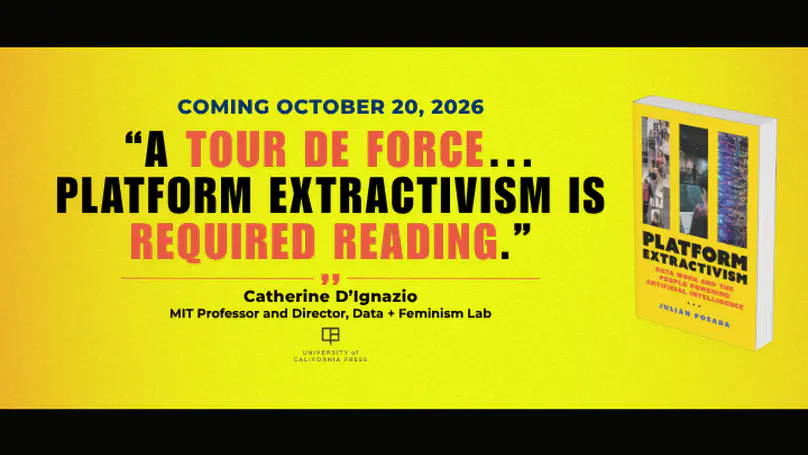
My book, Platform Extractivism: Data Work and the People Powering Artificial Intelligence (University of California Press, October 2026), argues that the development of datasets for artificial intelligence depends on labor organized through “platform extractivism,” a system that exploits economic instability to capture value from precaritized workers. By reframing AI data work as a continuation of historical extractive relations, the monograph intervenes in debates on the future of work and the hidden costs of AI and digital platforms.
My academic articles have been published in journals including Big Data & Society, Information, Communication & Society, Frontiers in Artificial Intelligence, and the Proceedings of the ACM on Human-Computer Interaction. My research and commentary have appeared in media outlets including The Economist, Fortune, WIRED, the MIT Technology Review, and NBC. My work has been supported by the International Development Research Centre and the Social Science Research Council, with funding from the MacArthur, Ford, and Surdna foundations.
I hold a Ph.D. in Information Science from the University of Toronto and have held visiting appointments at the Massachusetts Institute of Technology and the Weizenbaum Institute. I am fluent in Spanish, French, and English.
- Platform Labor
- Data Studies
- Social Computing
- Digital Ethics
- Information Policy
Ph.D. in Information Science, 2022
University of Toronto
Master's degree in Sociology, 2018
School for Advanced Studies in the Social Sciences
Maîtrise degree in the Humanities, 2016
Sorbonne University